Ethics in Research
For September 19, 2018
Hi WN@TL Fans,
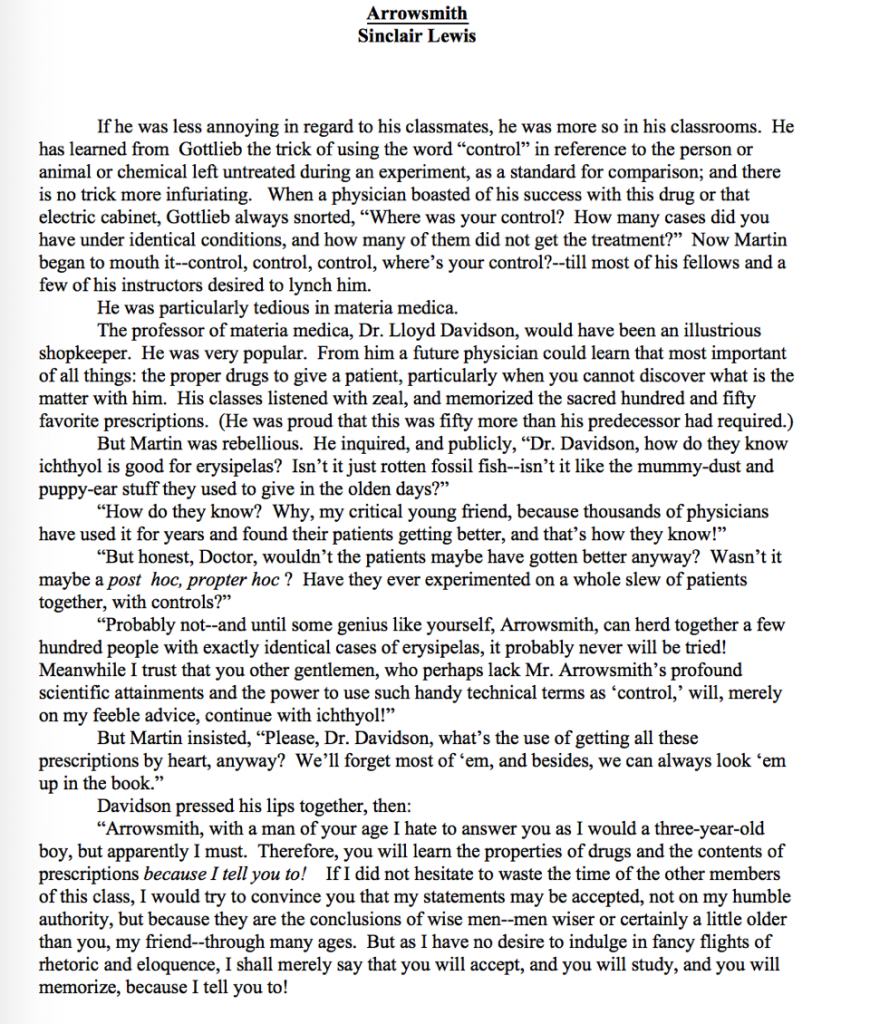
When I was in graduate school at the University of Illinois I read “Arrowsmith”, Sinclair Lewis’s 1925 novel dwelling on the medical research enterprise. I was smitten by this pivotal passage early in the book.
 Robert Thorne is a neuroscientist whose work has focused on leveraging deep knowledge of physiology, CNS structure, and the blood-brain and blood-cerebrospinal fluid barriers with a variety of methods in order to identify how best to deliver antibodies, oligonucleotides, and gene therapy vectors to the brain (https://apps.pharmacy.wisc.edu/sopdir/robert_thorne/). In addition to maintaining an active laboratory (lab website: https://pharmacy.wisc.edu/thorne_lab/research/), he has had significant roles teaching systems neuroscience, drug delivery, pharmacokinetics, research ethics and other graduate and professional courses while a member of the faculty in the Pharmaceutical Sciences Division of the University of Wisconsin–Madison’s School of Pharmacy. He previously delivered a WN@TL lecture entitled ‘Special delivery: how drugs and other substances get into and move around within the brain and spinal cord’ on March 5, 2017 in honor of Brain Awareness Week (https://www.youtube.com/watch?v=prKmJLn3jAc&t=419s). Thorne has had a longstanding interest in research ethics, biomedical ethics, and best practices associated with mentoring junior scientists.
Thorne earned his PhD in Pharmaceutics from the University of Minnesota in 2002 and then did postdoctoral training for 6 years in physiology and neuroscience at the New York University School of Medicine (NYC). He joined the faculty at UW–Madison in 2010. He previously chaired the 2016 ‘Barriers of the CNS’ Gordon Research Conference and is a member of the editorial boards of both Fluids and Barriers of the CNS and the Journal of Cerebral Blood Flow and Metabolism. He is also the elected Vice President (President-elect) of the International Brain Barriers Society, a global organization responsible for leadership and directing worldwide initiatives related to the CNS barriers and drug delivery fields.
===
Next week (September 26) an exquisite puzzle from the intriguing worlds of plant viruses and human viruses: how is it that some sucking insects (eg, aphids, mosquitoes) transmit viruses, but only some viruses, and only between some plants or between some animals?
Clearly such insects are more than flying syringes, but what are the keys to their specificities from both ends of their aerial sorties? Tom German of the Departments of Plant Pathology and of Entomology probes the proboscis of the issue.
Hope to see you again soon at Wednesday Nite @ The Lab!
Thanks!
Tom Zinnen
Biotechnology Center & Cooperative Extension
UW–Madison